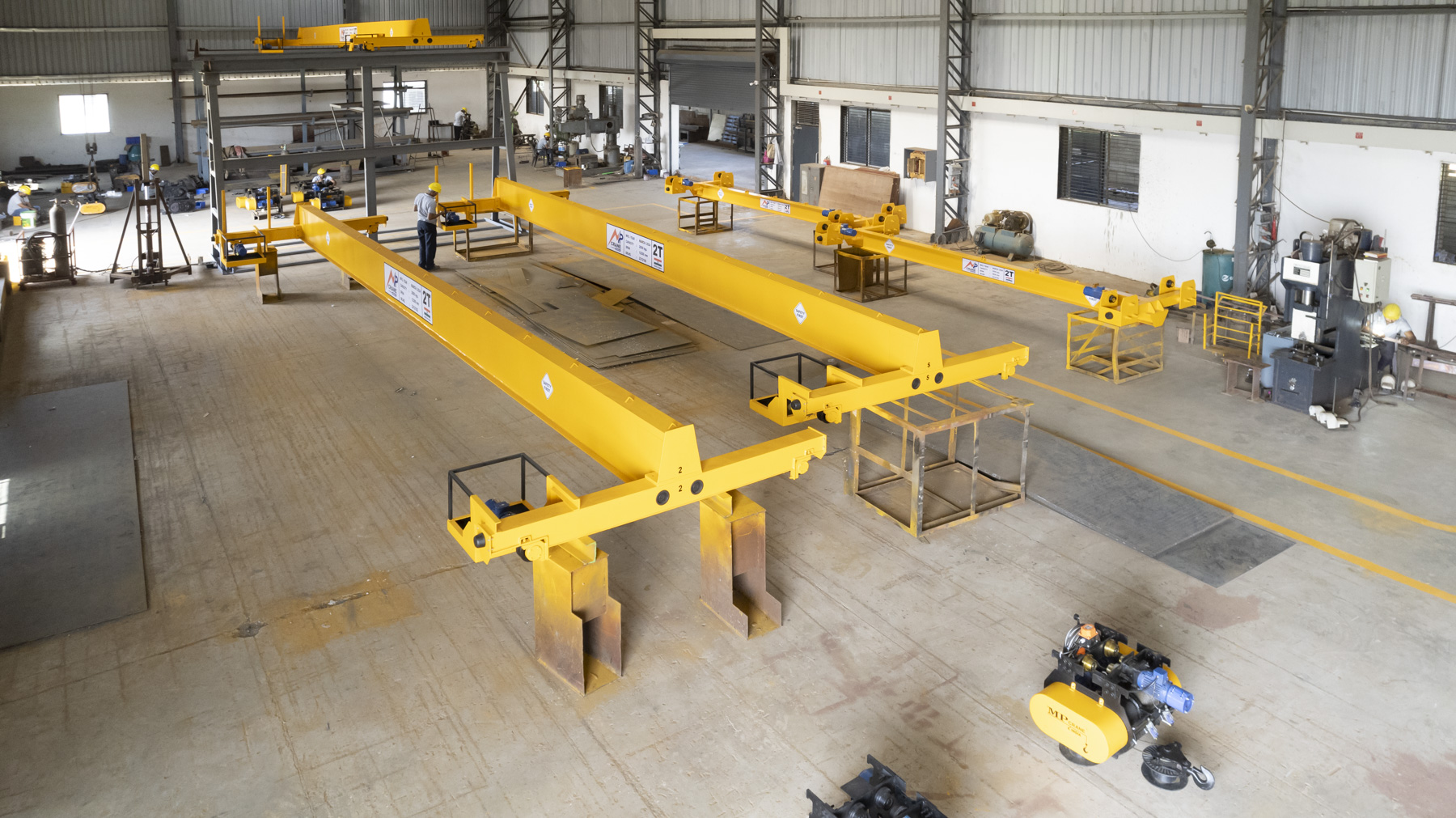
Setting up a workshop or a manufacturing unit and stuck deciding between a single girder and a double girder overhead crane? You’re not alone. This is one of those questions that comes up in almost every planning meeting, and even people who’ve worked in the industry for years sometimes pause before answering it confidently.
From a distance, both cranes look more or less the same: a beam running across the ceiling, a hoist hanging from it, doing the heavy lifting. But once you dig a little deeper, the differences start to matter a lot. They affect your budget, how much weight you can safely lift, how much ceiling height you actually need, and how the crane performs day after day on the shop floor.
So let’s go through this properly, without the technical jargon that usually makes these guides harder to read than they need to be.
Single Girder Overhead Crane — The Basics
A single girder crane uses just one beam, or girder, that stretches across the workspace and sits on end trucks that roll along rails fixed to the walls or columns. The hoist hangs underneath this girder and moves along it to pick up and shift loads.
It’s the simpler design of the two, and that simplicity is exactly why it’s so widely used. Less steel, easier installation, and a price tag that doesn’t scare off smaller businesses. Most single girder cranes handle loads up to around 20 tons, which covers a huge chunk of everyday industrial work: small workshops, auto garages, light assembly lines, and general-purpose warehouses.
If your business is based here and you’re searching for a single girder EOT crane manufacturer in Ahmedabad, this is usually the first option worth exploring, especially if your lifting requirements aren’t extreme and you want something reliable without overspending.
Double Girder Overhead Crane — The Basics
A double girder crane, on the other hand, uses two girders running side by side instead of one. The hoist sits on top of these girders rather than hanging below them, which changes quite a bit about how the crane behaves.
Because two girders are sharing the load instead of one, these cranes can lift far more often, well past 20 tons, and in heavy industries like steel or shipbuilding, sometimes into the hundreds of tons. The trolley sitting on top also means you get better hook height, which really helps in buildings where ceiling space is limited but you still need to lift as high as possible.
Comparing Them Side by Side
Here’s a quick table to make the differences easier to scan:
| Feature | Single Girder Crane | Double Girder Crane |
| Lifting capacity | Up to ~20 tons | 20 tons and well beyond, up to 500+ tons |
| Structure | One girder | Two parallel girders |
| Hoist position | Hangs below the girder | Runs on top of the girders |
| Headroom use | Slightly less efficient | Better hook height |
| Upfront cost | Lower | Higher |
| Maintenance | Simple, cheaper | More involved, costlier |
| Ideal for | Light to medium-duty work | Heavy industrial lifting |
Neither one is “better” in a general sense. It really comes down to what you’re lifting and how often.
What About the Cost?
Naturally, cost is one of the first things everyone asks about.
Single girder cranes are cheaper to buy and install, mainly because they use less material and the whole mechanical setup is far less complicated. For smaller businesses or first-time buyers, this lower cost makes a real difference.
Double girder cranes cost more, sometimes a fair bit more, because of the extra steel, additional engineering, and the more complex trolley mechanism needed to handle heavier weights safely. But if your operation genuinely needs that kind of lifting power, trying to cut corners with a single girder crane isn’t really saving money; it’s just creating risk. Overloading a crane beyond its rated capacity is a safety issue first, and a costly one at that.
It also helps to think a few years ahead. Double girder cranes are usually built to handle continuous heavy use, so while the initial cost is higher, they can end up being the more practical choice over time for high-demand operations.
Don’t Forget About Headroom
This is something people tend to overlook until it’s too late.
Since the hoist in a single girder crane hangs below the beam, it eats into your usable lifting height. In buildings with lower ceilings, this can genuinely limit how high you can raise a load.
Double girder cranes avoid this problem because the trolley sits on top of the girders instead of underneath. So for the same building height, you often get better hook height with a double girder setup. It’s a small structural difference, but it can matter a lot depending on your space.
Before finalizing anything, it’s worth actually measuring your building’s ceiling clearance and checking it against the hook height each crane type offers. It’s a detail that’s easy to skip during planning and expensive to fix afterward.
So, Which One Should You Actually Pick?
Go with a single girder overhead crane if:
- Your lifting needs stay under roughly 20 tons
- Budget is a real constraint
- You’re running a workshop, light manufacturing unit, or general warehouse
- You’d rather have a simple system that’s easy to maintain
Go with a double girder overhead crane if:
- You’re regularly lifting loads above 20 tons
- You’re in heavy industry: steel, shipbuilding, power plants, and similar
- Your building has height restrictions, and you need better hook clearance
- You need a crane built for constant, heavy-duty use over the long run
There isn’t one right answer for everyone. It depends entirely on your load, your space, and how often the crane will actually be running.
A Quick Word on Choosing the Right Supplier
Picking the crane type is only half the job; the manufacturer you choose matters just as much. A well-built crane from an experienced supplier will last longer, need less repair work, and perform more consistently under load.
If you’re based in Gujarat and searching for overhead crane manufacturers in Ahmedabad, it’s worth comparing a few options directly rather than going with the first quote you get. Ask about their build quality, after-sales support, and whether they can customize the crane to your facility’s exact span and height requirements. A lot of businesses in Ahmedabad’s industrial belt end up saving both time and money simply by choosing local overhead crane manufacturers in Ahmedabad who understand the regional working conditions and can offer faster installation and servicing support compared to out-of-state suppliers.
Final Thoughts
Choosing between a single girder and double girder overhead crane really comes down to knowing your own operation, what you’re lifting, how much, how often, and what your building allows for. Get those basics right, and whichever crane you land on will end up doing its job reliably for years without giving you headaches.